
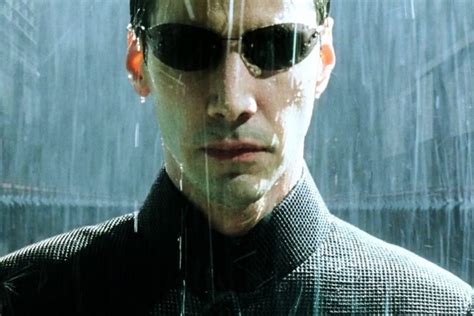
We have Lost our Children to the Matrix

I love the Matrix movie. I’ve probably watched it three-dozen times since its release. (I had a college buddy who could recite every line of Chevy Chase’s movie, Fletch. I might be able to do the same with the Matrix!)

One scene intrigues me: when Morpheus or Trinity, in the Matrix would dial up the “operator,” in putting the phone to their ears, they would then dissolve. The pixels of themselves in the Matrix would get reorganized into the flesh and blood in the Real World. Of course, they never left the Real World physically, but mentally, they would “jack” in to the Matrix and do their thing–except that their thing only happened in the minds of humanity jacked in at the time.

This is why Morpheus calls the real world (the non-jacked in world) the Real World. Of course, the Matrix was actually a part of the Real World though it couldn’t be accessed except via computer. Neo would sit in what looks like a barber’s chair while Tank would shove a huge probe into the hole on the back of Neo’s head and voila: Neo closes his eyes to the Real World and opens them to the Matrix.

The Real World was a post-apocalyptic world and it was bad in every way. Those who lived in the Real World had been set free from their role in the Matrix: they are no longer “connected.” They were free but not everyone liked that: Cypher didn’t. He longed to get back in; the Matrix was the escape because in it one could do whatever came to mind: dress, eat, play or kill. Someone jacking in from the Real World curates his experience however he wants. Everyone connected to the Matrix had roles to fill, families, friends, jobs, etc. so there were some limits for them. But not for those set free–they could jack in and be anyone and do anything. (Cypher wanted to be someone important…”like an actor.”)

In our reality, none of us is captive to the Matrix though many, many of us seek to be jacked-in to escape the Real World. Our children–from the young Millennials through to the three-year old sitting in the dentist office with her own iPad–jack in to social media, multi-player games or YouTube for h.o.u.r.s. Just as the thought of a steak was alluring enough for Cypher to return to his pre-Real World slavery in the Matrix, the personally curated online experiences of our children draw them in further and further.

But there’s more. Michael Toscano wrote in First Things an opinion piece titled, “Ensnared in the Web.” He highlights the fact that “Big Tech” hires top neurologists, psychologists and behaviorists to create a product that stimulates an endless supply of addictive Dopamine. He writes of the “search” bar:

The search is presented to us as a tool for looking outward, but in fact is is a biopsy. It “extracts” our interests, habits, convictions, hopes, friends, purchases, politics, exact location and much more….The vast ocean of digital information which requires tools to navigate became the pathway for control.

Michael Toscano, “Ensnared in the Web” First Things, May 2022.

On organizational levels, Big Tech is afflicted with the same tendencies of manipulation, greed and power that each of us has. Only armed with the right algorithm and we go where it wants us to go. And those most affected? They are the least wise and therefore most unsuspecting: tweens, teens and young adults.

Instead of taking the blue pill they turn on the blue lights of the screen. And no sooner than a swipe and voila! They are jacked-in. In the Matrix, to be jacked-in meant you were at risk of discovery by the Agents. Once found it was run or die. At one point Neo asked Morpheus what happens if one dies in the Matrix. “The body cannot live without the mind,” he answered. The one killed in the Matrix slumps in his chair in the Real World: his eyes closed, lifeless, breathless–captured by the Matrix never to be released again.

  • How many of us have walked into our children’s rooms to see them: eyes reflecting the blue light, virtually breathless, apparently lifeless, slumped–captured by the online world (maybe) never to be released again?

What is there to be done? How many of us realize there is no neutral ground anyplace in Creation–including the Web? Do we instruct our children on its dangers? Do we believe there is danger there? Are we suspicious enough of Big Tech? The whole world is moving everything possible online in the vain belief that perhaps it can be a place of utopia. Free speech! Freedom to browse and surf! Freedom to comment! Freedom to vent and curse! Freedom to perform without risk–a place where “I can be somebody important…like an actor”!

The reality is that smartphones don’t belong in the hands of children. They hardly belong in the hands of young adults. Perhaps it’s true that parenting has never been so hard. It is two voices (hopefully) against a Legion of them: truly, what can be done? Pray. Pray for what the apostle Paul warned in Colossians:

See to it that no one takes you captive by philosophy and empty deceit, according to human tradition, according to the elemental spirits of the world, and not according to Christ.

Colossians 2:8

Take your family to a confessing and faithful church. Put the kids in Sunday school and youth group. Encourage other adults to commit to friending your kids. Toss your kids outside and tell them to play. Limit the time they spend on devices and limit the places they can go when they’re on them. Go camping or biking or long-boarding. Educate yourself on the dangers of social media.

You can do it. They won’t like it but what do they know? We might not be able to reform Big Tech but we can educate our children and grandchildren and “play the man” like we’re supposed to do.

White Paper #12: Our Framework: the Fall

With this paper, we jump into the second major part of our framework for considering sex and gender: the Fall. For those who aren’t familiar, an overarching way to view the story of redemption in Christ is “Creation, Fall, Redemption and Glorification.” This white paper begins our look at the Fall.

First, a review. We start with the six (6) facts of Creation:

  • We are all made in God’s image
  • Each person is either male or female
  • God blessed us in our maleness and femaleness
  • To be male and female is necessary for the work the Lord has for us
  • Male and female highlights the relationship between Christ and the church
  • There is no interchangeability between the sexes

Then, from there we recognize “Biology is apology”: It tells us our sex and it tells us our roles. Next, we consider how these things speak to us about “identity” and “identifiers.”

  • Identity is what we have in common with every other man, woman and child: male or female, in God’s image, subject to the Fall, worshipper.  
  • Identifiers are person-specific and can be good and godly or bad and sinful.  

Pronouns matter—but not that much.  And, in this mission, we accept people with an agenda.

Why is all this necessary?  Man’s original disobedience.

The impact of the fall cannot be underestimated. Now, thorough-going fallenness is everywhere.  We have only short glimpses of holiness and wholeness, but they are quickly eclipsed by pain, uncertainty, sinful thoughts or persecution. In the Reformed faith, we categorize the impact of the fall as “total.”  Every human born is born with the indelible imprint of the fall upon his or her soul.  David recognized this in Psalm 51:5

Behold, I was brought forth in iniquity, and in sin did my mother conceive me.

His mother didn’t conceive him sinfully—from fornication—but having been conceived, he was already infected by sin. Every part of us has been infected with sin and, while we are not as bad as we could be, every part of us has been tainted. How did this happen?  This is probably the most important interpretative key to our day-to-day experiences: Genesis 3:1-12.   Let’s look at the progression from sinlessness to sinfulness in these verses.

#1: The challenge to God’s honesty and provision: 3:1

Now the serpent was more crafty than any other beast of the field that the Lord God had made. He said to the woman, “Did God actually say, ‘You shall not eat of any tree in the garden’?”

This is a fundamental charge against God that is inherent in sin: He is not telling us everything, we deserve to know more, He is depriving us, He is not good—sin speaks all of this all of the time. We have to take matters in our own hands because we know better

#2: Eve’s repetition of God’s words + an interpretation: 3:2-3

And the woman said to the serpent, “We may eat of the fruit of the trees in the garden, but God said, ‘You shall not eat of the fruit of the tree that is in the midst of the garden, neither shall you touch it, lest you die.’ ”

We don’t know why Eve added the prohibition of touching the tree; perhaps she and Adam agreed that’s what God’s command required. Do we know better than God such that we can add to His word?

#3: Serpent’s challenge: 3:4-5

But the serpent said to the woman, “You will not surely die. For God knows that when you eat of it your eyes will be opened, and you will be like God, knowing good and evil.”

What is interesting about the serpent’s challenge is that it is so close to the truth that it seems compelling. If they ate, they would know good and evil, but if they ate, they wouldn’t know it sinlessly because the process of knowing it was sin.

#4: Eve’s deception and disobedient action: 3:6

So when the woman saw that the tree was good for food, and that it was a delight to the eyes, and that the tree was to be desired to make one wise, she took of its fruit and ate, and she also gave some to her husband who was with her, and he ate.

Eve was deceived into thinking, (a) the tree was actually good vs. deadly, (b) it was beautiful as a tree planted by God so it couldn’t be all bad, (c) it should be taken so that she could be wise like God—why wouldn’t God want that? Her deceit led to her sinful thoughts which led to her sinful actions—including giving some of the fruit that she knew was forbidden to her husband. In this action, she prioritized her flesh over her soul; as did Adam.  The physical / mental took priority over the spiritual—sound familiar?

  • This is sin’s pattern: the flesh over the soul, what I want over what God says I need. 

She sinned against God and then against her husband.  He followed suit by sinning against God and his wife.  

#5: The result: the serpent was right 3:7

Then the eyes of both were opened, and they knew that they were naked. And they sewed fig leaves together and made themselves loincloths.

Isn’t it interesting that their recognizing their nakedness made them want to cover it?  Previously, they were naked and without shame. Their bodies were now a problem, “Simply put, spiritual sin has physical effects.”[1]. They each covered the one thing that was central to how God made them and what He made them to do: be fruitful, multiply and fill the earth. The Fall creates inherent opposition to how we are made and what we are made to do.  Each of us is inclined—naturally—to oppose how we are made and what we are made to do.

#6: They hid themselves from God: 3:8

And they heard the sound of the Lord God walking in the garden in the cool of the day, and the man and his wife hid themselves from the presence of the Lord God among the trees of the garden.

Them hiding from God is odd since they ate of the Tree believing it would make them like God. They knew they weren’t like God but were guilty before Him—so they hid in order to act like God wasn’t there. The apostle Paul picks up on this in Romans 1:18.

For the wrath of God is revealed from heaven against all ungodliness and unrighteousness of men, who by their unrighteousness suppress the truth.

#7: God forces Adam to take responsibility for what had happened: 3:9-11

But the Lord God called to the man and said to him, “Where are you?” And he said, “I heard the sound of you in the garden, and I was afraid, because I was naked, and I hid myself.” He said, “Who told you that you were naked? Have you eaten of the tree of which I commanded you not to eat?”

He should’ve guarded the Garden including Eve: he did not. He disobeyed God and His command and, as the leader, he would stand before God and admit it.

#8: God calls them both to account and no one took responsibility! 3:12-13

The man said, “The woman whom you gave to be with me, she gave me fruit of the tree, and I ate.” Then the Lord God said to the woman, “What is this that you have done?” The woman said, “The serpent deceived me, and I ate.”

God called the man to accept responsibility: he blamed the woman. God called the woman to accept responsibility: she blamed the serpent. No one took responsibility for what they did. The Fall makes us inclined to blame someone else for our actions, to defend ourselves as right and not take responsibility: “admit nothing, deny everything and always make counter-accusations.”

Key takeaways

  • Sin is always speaking a challenge to God’s ordered world: its nature is to twist what God has made and said and bend it to its opposite.  All sins are lies.
  • When we add to God’s word, we subtract from the freedom we have in Him.
  • Our enemy will work hard to soften the edges of his allurements: he will work to convince us what he proposes is just a version of what God does.
  • We are at risk of being deceived by him if we depart from God’s word and forget God’s character.
  • Sin will cause us shame that we will work to hide.
  • Sin will lead us to blame others.

[1] Owen Strachan and Gavin Peacock, What does the Bible teach about Transgenderism? (Christian Focus; 2020), 43.

White Paper #11: What can we do about pronouns?

During the seminar, I was asked how should we handle a person’s request that we use a specific pronoun even when it violates the person’s biology?  My initial answer was to refuse to accept the request to use preferred pronouns: “It isn’t speaking truthfully,” I reasoned–and I’m correct, almost.

However, as the questioner and I spoke further off-line, she told me that with a relationship in progress and trust being built, it might bring the whole house down if she were to change in mid-stream.  I think there’s wisdom in that. Indeed, the priest in me agreed while the prophet frowned.  I’d suggest to you that it should do that to all of us: create a tension, a grace-truth tension.

This issue might be analogous to Jesus’ approach to the Samaritan woman.  He did not start the conversation with a discussion about her marital status; what may be analogous to our “pronoun issue.” He was ultimately more interested in her soul than her sexual habits.  However, neither did He ignore her marital status: He eventually asked her to go get her husband.

The apostle Paul did something similar at the Areopagus in Acts 17:22-24:

So Paul, standing in the midst of the Areopagus, said: “Men of Athens, I perceive that in every way you are very religious. For as I passed along and observed the objects of your worship, I found also an altar with this inscription: ‘To the unknown god.’ What therefore you worship as unknown, this I proclaim to you.

Paul’s first words weren’t, “My what a bunch of pagans you are!”  Though he would not have been wrong!  He met them where they were—in respect and dignity—and proceeded from there. If we are thinking biblically, we know we should be referring to ourselves according to how God made us: biology is apology. However, those walking in darkness by definition are ignoring and suppressing how God made them.  

Their demand that we use their preferred pronouns is a statement of three rebellious things:

  1. “I refuse to accept how God made me.”
  2. “I am sovereign over my life.”
  3. “You will help me be happy.”

Yet they are statements made by one captive to do the devil’s will—a sinner and a sufferer, remember? Where do we start?  What do we address?  We “accept them with an agenda” (I first saw this phrase in Paul David Tripp’s book, “Instruments in the Redeemer’s Hands.”)

  • We accept them: they are like us: male or female, image-bearing, subject to sin and worshippers.  They have inherent dignity and value and worth.  

We were just like them in our sins when we were unconverted—and we are more like them than unlike now. We accept them (even, at times, agreeing to use their pronouns) but with an agenda.  What is the agenda we must have with those who are seeking their happiness in sexual brokenness and expressive individualism? Is it simply to get them off their crazy pronouns? No: that they become worshippers of God through Jesus Christ. 

Remember our new mission field—as needy as any mission field—is characterized by confusion, anger and misdirected joy-seeking in distorted sexuality. The most loving and compassionate thing we can do is lead those who are broken to wholeness in Christ. This agenda sets the boundaries of our love: we are ambassadors of Christ. So:

  • We won’t follow them into sin—we won’t become like them
  • We won’t forsake our confession of Christ or our walk with Christ
  • We won’t minimize the biblical teaching on sexuality
  • We will be honest about our perspective
  • We will be earnest about our interest in getting to know the other person
  • We will display the fruits of the Spirit

What cannot be part of our agenda?

  • Celebrating brokenness as normal and desired: brokenness isn’t normal—it is not God’s design and shouldn’t be celebrated
  • Advocating for policies or actions that make brokenness easier or more acceptable
  • Shaming those who are broken as if something weird is happening to them

What an agenda like this means is that we go at God’s pace in the relationship. This is very hard especially if the one we are working to accept is dearly loved: we want them to be free and the time is NOW! That is normal and it is good but we can’t step into God’s providential plan apart from the fruit of the Spirit and wisdom. Jesus’ work with the Samaritan woman is very instructive.

Even in the midst of a patient pursuit of a person’s worship well-being, there are at least seven reasons why we need to have an agenda: 7 TRUTHS.

#1: God chose the person’s sex, the parents chose the person’s name—our pronouns are received not declared: it is sin to ignore those.

#2: We cannot accept self-sovereignty: the Bible tells us we are not gods over our lives. 

#3: Happiness in this life will not translate to eternal life apart from Jesus Christ; eternal life for the soul has to be our focus.

#4: Is it loving and respectful to God to ignore how He created the person using pronouns that aren’t true?

#5: Does it speak truthfully to the person about who they really are?  

#6: Is it dignifying to them —does it honor them are created image-bearers—to speak falsely to them about them?

#7: What is to be gained by continuing on without confrontation?  For us or for them?  Eventually Jesus spoke to the woman; eventually Paul spoke to the Athenians.  So must we.

To accept them with an agenda is what Jesus did with the woman at the well—He did not shame her or mock her or condemn her, remember? He was willing to engage her.  He dignified her by speaking to her crossing over a number of cultural taboos. He preached the good news to her before addressing her sexual sin. In His honesty, He called her out eventually. He didn’t ask her to leave the man she was living with but rather leave the false religion she was committed to.

Jesus had an agenda—and that agenda meant wisdom and patience in not immediately addressing something that was sinful and obvious.

Pronouns matter yet souls matter more than what pronouns someone chooses to use about themselves.  If we accept people with an agenda—and that agenda is to get them to see who they are based on what God’s word says—them we might have to wade through and compassionately tolerate things we know need to change.